Choosing the Best Color Temperature for Garage Lighting
Garages aren’t just a place to park our cars. Garages are workshop areas, or even sometimes entertainments spaces.
When using your garage as a place to do your work, to hang out, or just to park your car, getting the best color temperature for your garage lighting is critical.
Bad lighting means being unable to do your work well, eye strain, and general frustration. And getting color temperature for your garage right means it’s a place you’ll always want to be!
So this is a simple guide to understanding color temperature for garages.
For most applications, the best color temperature for garage lighting is between 4000 and 5000 Kelvin.
In this post, we’ll cover why this is the best color temperature level for your garage space. We’ll also explore what color temperature is and why it matters.
Table of Contents
What is color temperature?
You might be confused by the term “temperature”. How does light have a temperature? The complex answer is “physics” — the literal definition of color temperature is the temperature that you’d have to get an ideal opaque uniform “blackbody radiator” to to emit light of that colour.
In simpler terms, color temperature is a method of describing the color tone of different lights. You’ve probably heard the terms “warm lighting” and “cool lighting” before. These two types of color temperature are often contrasted with each other.
You might have also noticed that the lights in an office are harsher than the light of a dimly lit bar, or that the light from your camera’s flash is different to the colour from a camping lantern. These are also examples of color temperature.
Color temperature is measured in Kelvin (K). Generally speaking:
- A warm color temperature will have a lower Kelvin value, usually between 1500K and 3000K. Light with a warm color temperature tends to have a hue ranging from orange to yellow.
For example, a candle will measure around 1000K, while sunrise and sunset give off warm light at around 2000K to 3000K.
- Light with a cool color temperature will have a higher Kelvin value, ranging anywhere from 5000K to 10,000K.
Different degrees of natural sunlight usually fall on this cooler end of the color temperature spectrum, with typical noon daylight measuring around 6000K to 7000K. Lights with a cooler color temperature tend to have a blue tone.
Towards the higher end of the Kelvin scale, some color temperatures can be harmful if used in artificial lighting.
Generally speaking, any color temperature greater than 6500 k will start to put strain on our eyes and tire your eyes (though contrary to popular belief, it won’t damage your eyes).
The following table (from Wikipedia, simplified somewhat) will give an overview of what different color temperatures look like.
| Temperature | Source |
|---|---|
| 1700K | Match flame |
| 1850 K | Candle flame, sunset/sunrise |
| 2400 K | Standard incandescent lamps |
| 2550 K | Soft white incandescent lamps |
| 2700 K | “Soft white” bulbs |
| 3000 K | Warm white bulbs |
| 3200 K | Studio lamps |
| 5000 K | Horizon daylight |
| 5000 K | Tubular fluorescent lamps or cool white / daylight fluorescent lamps |
| 5500 – 6500 K | Vertical daylight |
| 6500 K | Daylight, overcast |
| 6500 – 9500 K | LCD or CRT screen |
| 15,000 – 27,000 K | Clear blue poleward sky |
Why does color temperature matter?
So now that we know what color temperature is, why is it important? There are several reasons why you may want to control the color temperature of lighting in a space.
Firstly, practicality. Having the right color temperature is a practical choice.
Light with a cooler color temperature usually creates a starker contrast between objects, allowing you to see things more clearly. This can be useful for a workshop, for example.
So if you’re trying to do detailed work, like fine electronics, then a higher color temperature will let you do it with less eye strain.

Commercial stores like supermarkets and hospitals will usually use a slightly cooler color temperature of 3500K and over, balancing between clarity and a pleasant environment.
Secondly, comfort. Home light solutions are typically more optimised for all-day comfort, which means warmer (lower value) color temperatures.
Most domestic light bulbs will cover a Kelvin range between 2700K and 5000K. In the past, classic incandescent light bulbs (with a tungsten filament) could only operate in the lower end of this range, but modern LED and compact fluorescent bulbs can produce light in practically any part of the spectrum.
So when considering the best color temperature for garage lighting, make sure you bear in mind your trade-off in comfort vs practicality.
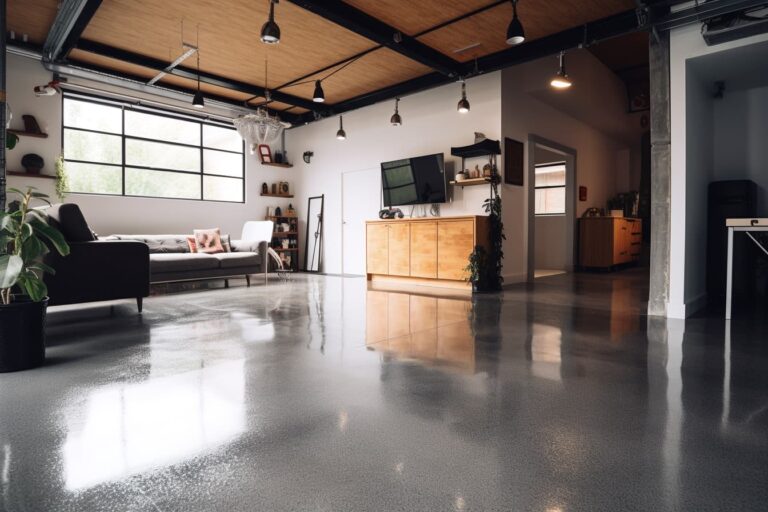
Thirdly, design. Color temperature is an aesthetic choice that complements other aspects of your garage.
If your garage is decorated with more natural tones such as brown or tan (e.g. a lot of wood), then a warmer light is your best bet. For spaces painted with blue, gray, or white (or those with a lot of metal), a cooler color temperature may suit it better.
Finally, psychological benefits. Different color temperatures can have psychological effects. For example, we usually feel more relaxed when exposed to warm light such as a candle or a fireplace. This is ideal for bedrooms or living rooms.
By contrast, we’ll generally feel more awake and alert when exposed to cool light temperatures. Cooler lights may be used more in offices, workspaces, and hospitals.
Which is the best color temperature for a garage?
The answer to this question depends on what you’re using your garage space for. But for most people, a cooler color temperature of between 4000 and 5000 Kelvin is probably going to be the best garage lighting color temperature.
This temperature range is a good middle ground suited for a range of different uses for your garage. It’s stark enough to help with DIY projects when you need to see things clearly, but it’s not so cold that the light will be harsh on your eyes.
Most garages are probably going to be painted in more utilitarian colors such as gray or white, with more metals than woods, which both work well with colder light temperatures.
But even in this Kelvin range, there are going to be applications better suited to either the lower end or higher end (between 4000 K and 5000 K) color temperatures. Let’s look at a few different garage uses and compare a 4000 K vs 5000 K LED garage light.
- Workout space/home gym: Many people have “garage gyms”. As discussed earlier, cooler light temperatures make us feel more active, so a gym will usually use colder light or let as much natural daylight in as possible. Our 4000 K to 5000 K spectrum suits the needs of a gym, especially if the color temperature is around 5000 K.
- DIY/workshop: For those using their garage as a home workshop, you want to see what you’re doing in detail without being blinded by overly harsh light. This is especially true if you’re working with wood. Again, the 4000 K to 5000 K color temperature range is ideal here. Lights that are closer to 4000 K will be the most effective, as the slightly warmer tone will work well with natural wood tones.
- Working on your car or motorcycle: If your garage is being used for more commercial applications or for working on your car, opt for higher clarity of around 5000 K so you can see what you’re doing.
Conclusion — What’s the Best Color Temperature for Garage Lighting?
When it comes to garage lighting color temperature, cool lighting measuring between 4000K and 5000K is going to be the best option for your garage.
This temperature range is a nicely balanced spectrum that can be useful for a wide variety of activities including craft work, working on your car/bike, or even using your garage gym.
Colder temperature lights will also work better with the typical metal and stone colors of garage walls and floors, as well as helping you to feel more alert during important projects.