Garage Lighting Ideas – A Comprehensive Buyer’s Guide
When building your dream garage or workshop, you imagine it a certain way — extremely organised, always tidy, and very easy to work in. Part of that is being well-lit.
Lighting a garage is hard. It seems to be an afterthought in house design. After all, lighting is most important in your actual house, where most people live.
But you live in the garage, and so you need to have a well-lit garage! To light up your garage properly, here are a bunch of garage lighting ideas to get your creative juices going in garage design.
Choosing the best garage lighting options depends on what you do in the garage, how big it is, where it’s situated, your power options, and what you do in the garage. If all you do is chill out, it’s a bit different to if you’re restoring a vintage car in the dead of winter.
So here’s a buyer’s guide to lighting up your second home — everything you need to think about.
Table of Contents
Garage lighting ideas — In a nutshell
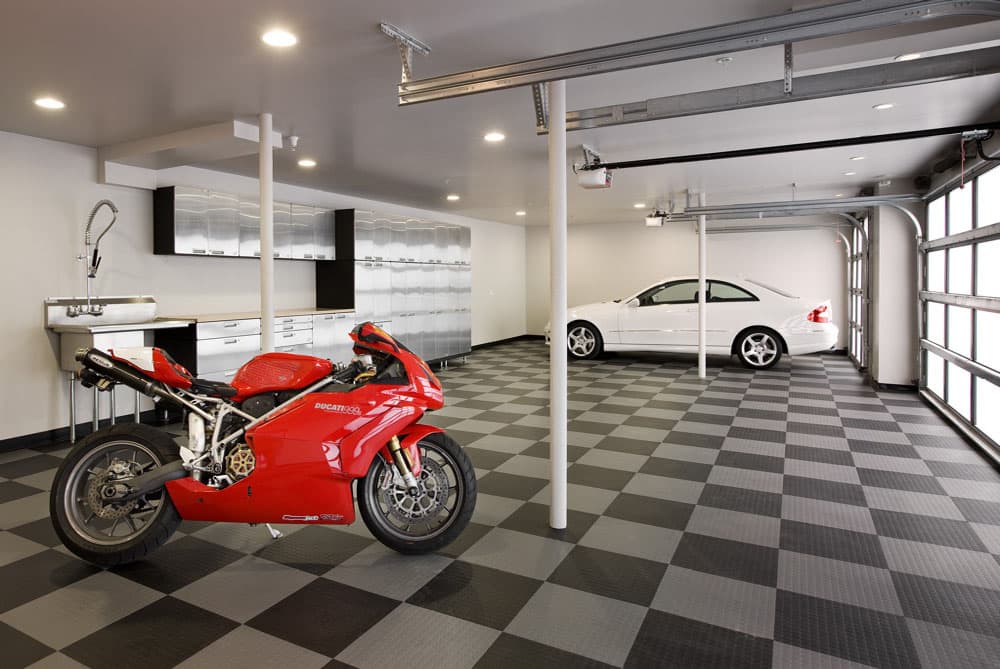
It’s easy to get lost among a plethora of garage lighting ideas you can find by browsing around the web.
But a brief summary of all the below is to get for your home garage (or workshop)
- Lighting that is task-focused (can illuminate a work area) as well as of general use
- Bright (high CRI) lighting, preferably LED
- Multiple kinds of lighting, to layer light
- Enclosures that are sturdy enough to withstand a harder environment
Choose your lighting fixtures by purpose
Obviously, what you want to do in your garage informs how you’re going to illuminate it.
We all have garage fantasies (well, if you’re reading this guide, you might) — spending hours in there listening to music as we work on restoring an old car or motorcycle or doing a lot of metalwork or woodwork.
Having lighting that lets you do your work (or have your fun) without straining your eyes or even potentially damaging your eyesight is critical.
So think carefully about the kind of light you need. Ask yourself a few questions:
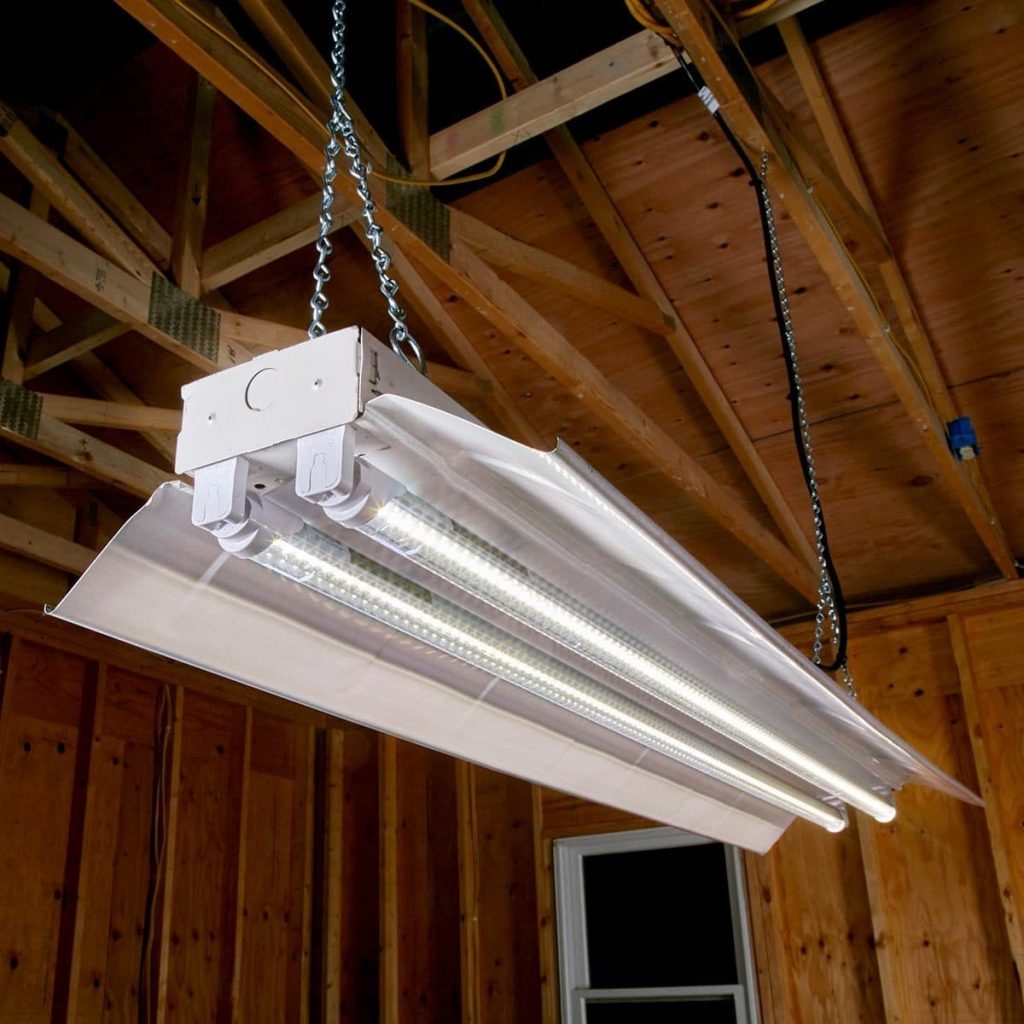
- Are you going to be working a lot on a workbench? If so, then you probably need shop lights. Shop lights hang from the ceiling and give you bright, even illumination
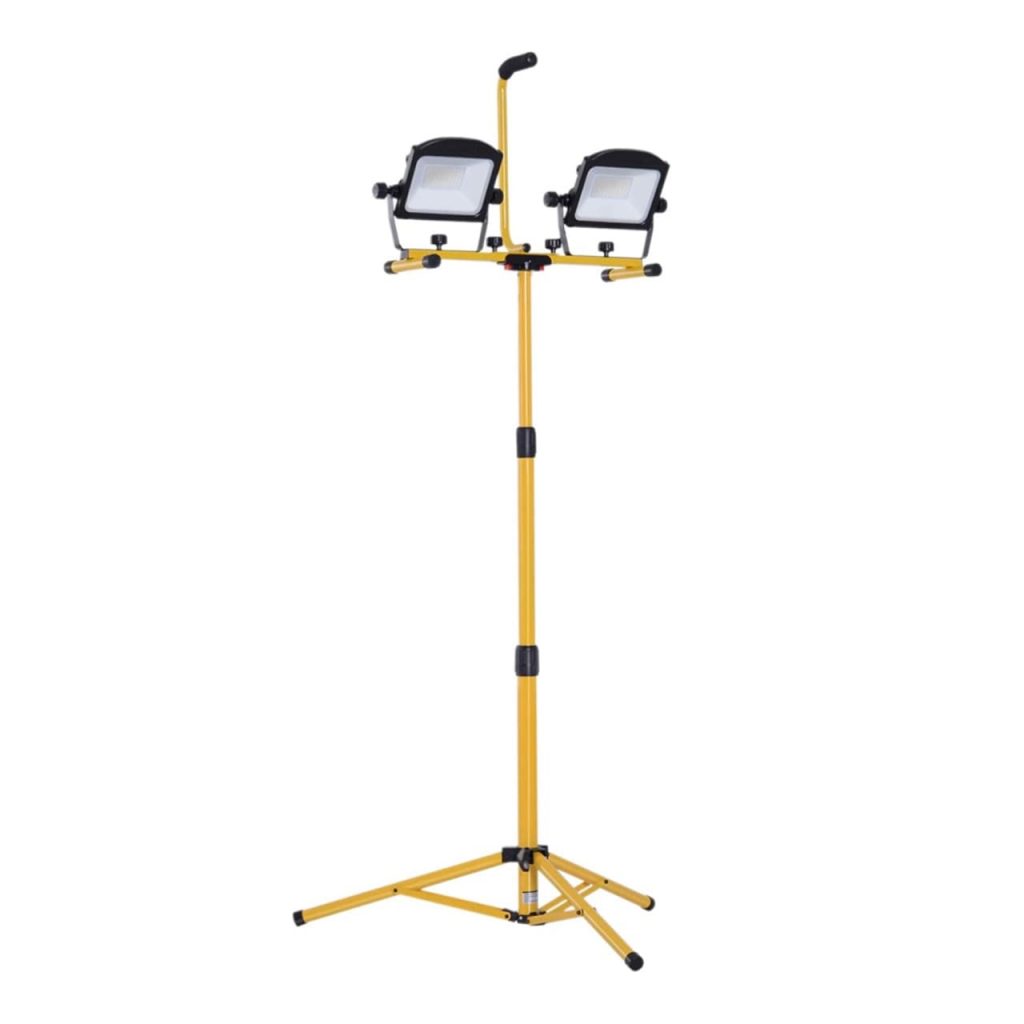
- Are you going to be working on a vehicle, away from a table? If so, you might need workshop lights. Workshop lights are directional light sources that illuminate something specific, like the side of your motorcycle or the inside of an engine bay. Some things to consider are how many you might need, how mobile they are, how resistant to heat/humidity they need to be, and how they’re fixed (either on stands or from the walls/ceiling)
- Are you going to just chill out in your garage? If so, some modern but durable light fixtures (like interior lighting, but more resistant to moisture and dirt) will make that more pleasant.
Getting the lighting right for the needs of your garage can be transformative.
Think about power sources
One of the hard things about lighting options for garages is how you’re going to power them.
Not because you’re short on power, but because sometimes, there just isn’t wiring near where you want to install a light. And you don’t want to have wires going everywhere.
There are three main ways you can power the lights of your garage.
- Mains electricity. Obviously, if there is mains electrical power near where you want to install lights, you’ve won. You probably should have an electrician do the work if you’re unsure, not just for your own safety, but to make sure your house is compliant with local regulations (which can come back to you if there’s a fire at some point and insurance kicks up a fuss).
- Battery power. For smaller light sources, or LED lights, you can actually run off a battery. This might sound crazy, and might involve a lot of charging, but if you’re in a tight spot then having a combination of batteries and a charging station may be more practical than running wires all over the place, especially if it’s a light you don’t use often.
- Solar power.Sometimes a garage is freestanding and not near the mains grid, so setting up a solar power system with batteries and inverter can be cheaper than running mains electricity there. Setting up a power system that can light up your garage and recharge your tools can be cheaper than you think, and will be the subject of another guide we’ll put together.
Use multiple types of lighting (“layered lighting”)
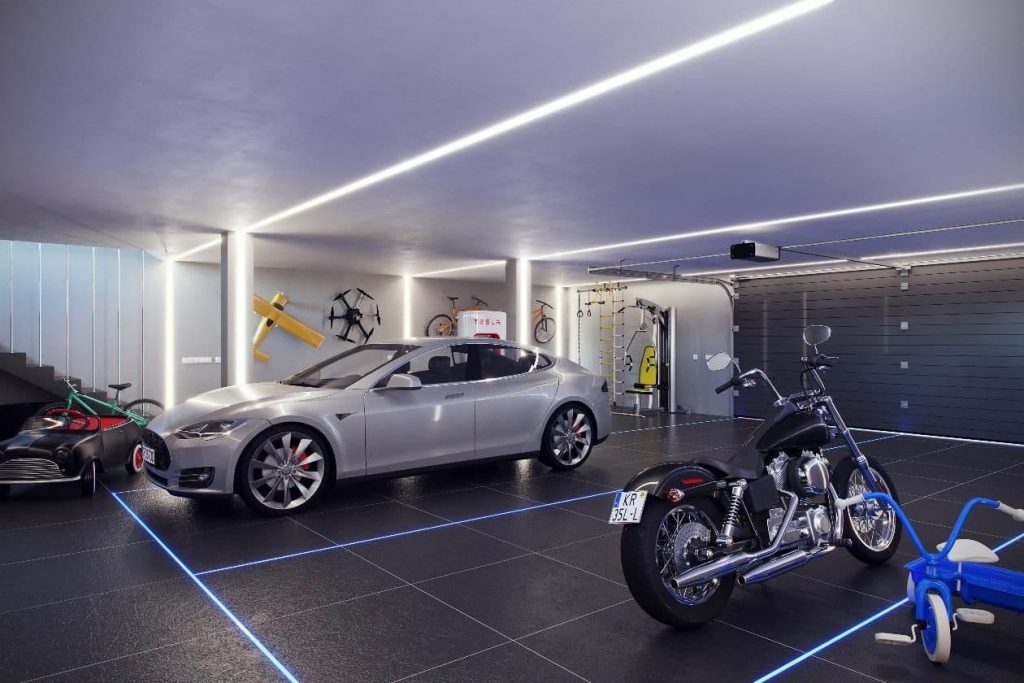
You don’t have to have just one type of garage illumination. You can use multiple light types from different sources.
The benefit of using “layered lighting” is that you get
- More even illumination
- More natural illumination — a few different light sources will contribute to providing a more natural white
- More flexibility in illuminating a specific part of the workshop
If you just have fluorescent lighting in your garage, you might find it a little cold and harsh. But if it’s paired with halogen or LED lighting, especially from different directions, the combination can be a lot more palatable.
Similarly, having outside ambient lighting (through a window or skylight) for a garage is pleasant, but might not be enough — a skylight can be expensive to install, and window lighting for a garage might not be enough to clearly see your work, particularly if it’s in the wrong direction or if your garage is surrounded by buildings or trees.
So think of not having just great natural light, task-specific lighting, and ceiling lighting, but a combination.
Choose the correct type of lighting bulb/element for your garage lighting
There are four main types of “bulb” or element you can use in a garage. (You can use these anywhere, but fluorescent is less common inside homes.)
Here’s a quick summary table of the different kinds of garage lighting bulbs/elements.
| Lighting type | Incandescent (Argon) | Halogen | Fluorescent | LED |
|---|---|---|---|---|
| Quality of light | OK/Warm — Soft yellow to bright yellow | Good — Bright yellow to white | OK/Cool — Cool to good light (depends on quality) | Very good — Daylight-like |
| Efficiency (light produced/power usage) | Very low | Low | Medium | Very high |
| Reliability | Low — replace often, and fails easily with moisture/dirt | Low — replace often, and fails easily with moisture/dirt | OK — Lasts longer than | Very high — almost never fails |
| Cost | Very low | Low | Low | Medium |
Incandescent bulbs (Tungsten)
These are traditional, old school light bulbs, that look like the classic light bulb emoji (💡). They’re fine, but they’re often not bright enough, and they use the most power.
Even if power consumption doesn’t worry you, the reason they use the most power is that they produce the most heat, i.e. most of the power they use doesn’t even become light. That heat means that there is often a maximum wattage that you can use in a light fixture without risking melting the fixture or causing a fire.
Another disadvantage of incandescent bulb lighting is that the light quality is often low — it’s “warm”. Warm lighting is great if you’re lighting a dimly lit restaurant jazz bar, but not ideal if you’re building a workshop where you want to see everything cleanly, not take selfies where you look good, as important as that is (and tungsten is great for that!)
Finally, old-school incandescent bulbs tend to fail. No surprise, because they work by putting a lot of light into a filament which gets hot. They’re also somewhat delicate, so changes in temperature and moisture reduce their life — all things that happen more often in a garage environment.
Traditional incandescent bulbs work by putting heat through a tungsten filament that heats up. It’s in an inert gas (like argon) which doesn’t react with the heated metal — unlike oxygen. If a bulb breaks, oxygen gets in and the tungsten pretty much immediately blows as it reacts with the oxygen in the air. This is important to know because it helps understand why halogen is an improvement.
Halogen lights
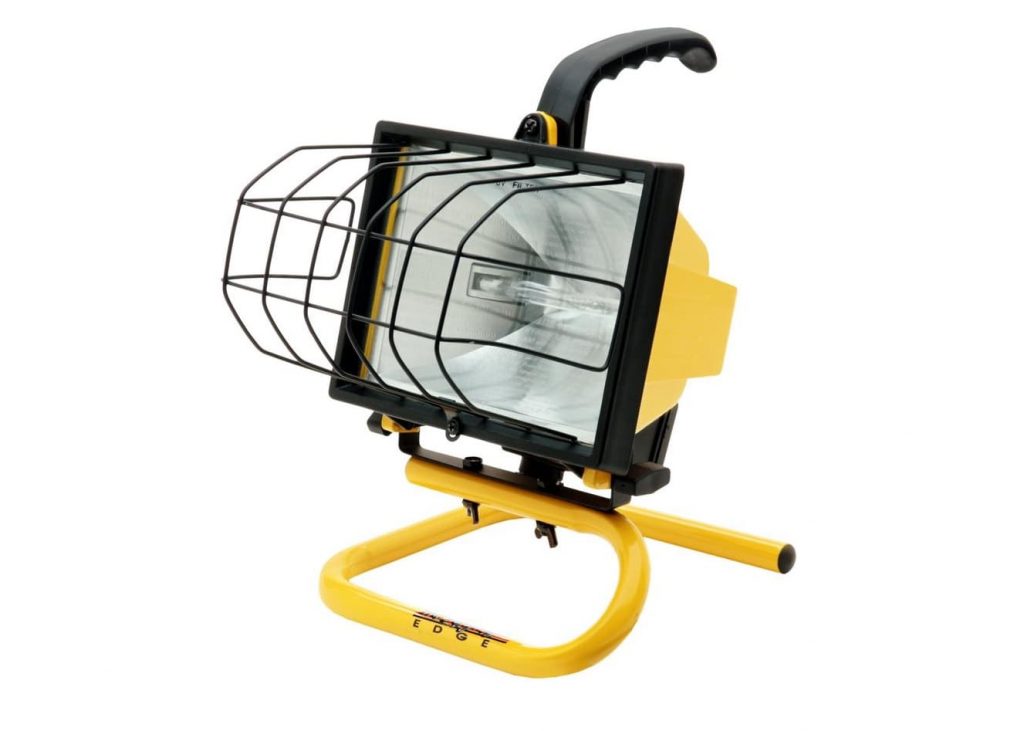
Halogen light bulbs are an improvement over traditional incandescent bulbs. They still use a filament (that can blow), but are more compact, have higher light output for a given size, and last longer.
The main difference between halogen light bulbs and traditional incandescent bulbs is that halogen lights have a bit of a halogen gas on the inside of the bulb. Normal incandescent bulbs just have argon gas.
What is a “halogen” gas? You might have to remember your high school chemistry! They’re gases that involve one of five elements: fluorine, chlorine, bromine, iodine, and astatine.
In a halogen gas light bulb, the electricity powers a tungsten filament, just like in a normal light bulb. The difference is the “halogen cycle”. The tungsten that evaporates off the heated element combines with the halogen gas, then floats around and re-settles onto the filament. This prevents the metal from settling on the glass, creating soot, and giving the bulb a heat spot on which to blow.
Halogen lights are compact and often get hot. This means you have to treat them with care when installing them — if you get a greasy fingerprint on them, it’ll heat up and form a hot spot that will then cause the bulb to blow. The same is true if you touch them during workshop work, or if much dust or grease settles on them. So they have to be in specially designed light units that enclose the bulb and keep them safe.
Fluorescent lights

You probably are familiar with fluorescent lights from most industrial or workplace type areas. They’re efficient (lower power than incandescent elements), provide crisp lighting, and are good at lighting large areas.
Many garages (including large underground parking garages) are lit with fluorescent lighting. This is great — less power usage, and higher light output. And fluorescent bulbs aren’t expensive. But it takes up more space and is less flexible — once you start going fluorescent, you can’t mix it up and go LED later, as the lighting tubes are always of a certain shape because of the way fluorescent light works (making a gas emit light) — unless you use compact fluorescent bulbs (below).
Fluorescent lights are very unfancy, and lighting fixtures for them can be simple and quite cheap. So if you have power in the ceiling, fluorescent lights can be a great option for work benches.
Something to bear in mind is that fluorescent lights need a “starter” to get them going. These last a long time, but one day when your fluorescent light still works but begins flickering a lot, it’s often the starter that fails. Keep a few on standby for this reason, as you can only get them from hardware stores (and a long round trip for a tiny device can be annoying).
–> Shop for starters on Amazon
Compact fluorescent bulbs (a.k.a. “Spiral” bulbs)
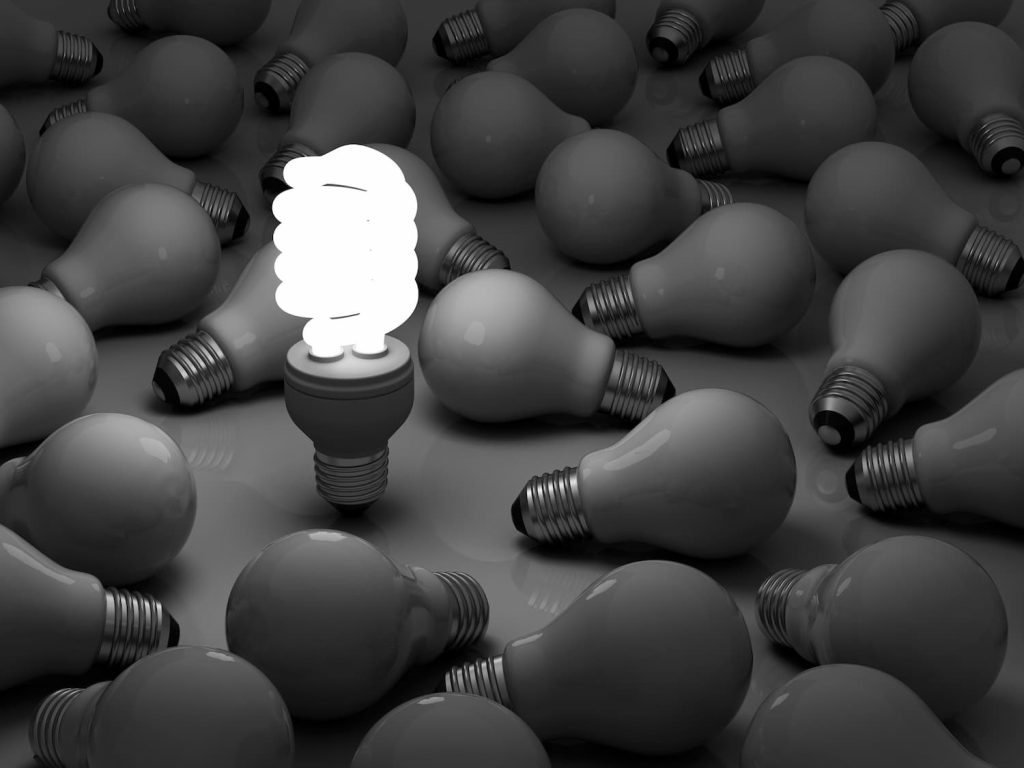
This is a subcategory of fluorescent lights because they use the same underlying technology but are presented in a standard bulb format, which means you can use them in a greater variety of lighting fixtures (basically anywhere that you normally would have used an incandescent bulb).
Compact fluorescent bulbs are basically “much more efficient light bulbs”. They’re also often aesthetically a little weird looking, so again, I wouldn’t use these in your underground jazz bar… but they’re a great option for the functional workshop.
Compact fluorescent bulbs are essentially a fluorescent tube that has been twisted around into a bulb shape. They have a starter inside them and are a standalone device — unlike with fluorescent tubes, there’s no separate starter to replace.
Modern compact fluorescents emit a broad spectrum of light, meaning that they’re not as cold and hard as office lighting can be.
LED lighting
Finally, the most modern (and perhaps least well understood) kind of lighting is LED lighting.
LED stands for “light-emitting diode”. Still confused? As are most people! It’s not critical to know what LED means, except that a diode is an electronics component (actually the foundation of transistors, which are the foundation of chips computers), and one that’s light-emitting is simply one that emits light.
A modern LED light bulb looks like a regular light bulb, though it’s usually opaque to diffuse the light evenly. But LED bulbs can take any shape you want them to. They can be long and thin (like fluorescent tubes), little bulbs like traditional bulbs, or large and flat.
In the old days, LEDs used to be just one colour, like red or green. Think back to 70s sci-fi movies about space ships.
Modern LEDs can emit a broad spectrum of light and produce light that’s higher quality even than halogen lights. Their main benefit is that they’re extremely efficient — they use a tiny fraction of the power to generate the same amount of light. In fact, a 10W LED can replace a 100W bulb. It varies slightly from manufacturer to manufacturer.
A second benefit of efficiency is heat output — an LED bulb won’t melt your light fitting if you put a high power one into an old fashioned lamp holder.
Finally, LED bulbs have no hot element that will eventually break. They’re very durable. Basically, LED bulbs last until you swap them out for something brighter, or if you smash them with a hammer.
LED lighting is still a bit more expensive, but it pays off easily — they rarely die (unless you break them), they use less power, produce more light (if you buy correctly), and the light is of higher quality (better colour). If you can the cash outlay, the long-term financial benefits of LED lighting are clear.
Use bulbs with enough illumination (“Lumens”), not necessarily wattage
Ever since we started using fluorescent and LED lights, “wattage” became confusing. That’s because watts are a unit of power, whereas units of illumination are lumens (or candles), and a lot of manufacturers are a little generous in their measurements (especially random sellers online).
So don’t get sucked in by photos or ads that claim to have extremely high light output in their lights — you might be unpleasantly surprised.
You might be used to thinking of light brightness in terms of wattage. Like, we all know that a 100W bulb is “very bright”, whereas a 60W one is “OK, and a 40W one is “kind of dim”.
The below conversion table might help you choose the right power output of light.
| Incandescent (Tungsten/Argon) | “25W” | “40W” | “60W” | “75W” | “100W” |
|---|---|---|---|---|---|
| Brightness level | Dim | Moody | Moderate | Bright | Very bright |
| Lumens | 250 | 500 | 800 | 1100 | 1500 |
| Halogen equivalent | 18-20 | 25-30 | 40-45 | 50-55 | 70-75 |
| Fluorescent (including compact) equivalent | 4-6 | 7-10 | 11-14 | 14-17 | 19-23 |
| LED equivalent | 3-4 | 5-8 | 8-12 | 11-17 | 15-23 |
Use lighting that is as “natural” as possible
Incandescent bulbs are known for producing warm light, and fluorescent bulbs are known for producing cool light. But what does this mean and how do you measure the light quality?
One important quality of light is how natural it looks. “Natural” means a broad spectrum of light that makes things look like what it “actually looks like”, i.e. how it would appear if it were illuminated by sunlight.
There are two measures you see for how natural or bright lighting is:
- Color temperature, and
- Color rendering index or CRI.
Color temperature
Color temperature is the traditional way of measuring light color. You’ll see it on the side of bulb packets as the Kelvin or K number.
A quick guide to color temperature is:
- 2500K: A warm yellow glow, like candle light
- 3000K: Soft white — a gentle illumination, good for bathrooms and kitchens
- 3500K: Neutral white, easy on the eyes, and good for day-round lighting
- 4000K: Cool white, good for professional environments like industrial garages and grocery stores, where detail is important
- 5000K: Bright white — ultimate clarity, where extremely bright light is needed to see and do things correctly. Like surgery rooms, sport stadiums, and high-tech industrial manufacturing areas.
- 6500K: Daylight. It actually has a blue tone to it. Used in greenhouses, plant lighting, and other agricultural purposes.
So what color temperature is best for your garage lighting? The best color temperature for garage lighting is probably in the 3500-4000 range — a bright white that’s natural, and which allows precise work, while not being so overpowering that it’s stressful to be in there.
Luckily you can get that color temperature range from a variety of lighting sources. Just bear in mind that if you buy bulbs from random sellers on eBay you can’t always guarantee that you’ll get what’s in the description.
Color Rendering Index or CRI
There are many ways of describing how warm the light output of a certain type of light is, but Colour Rendering Index or CRI is a common one.
The CRI specifically means “how good is this light at showing the true colour of something, like if I were in daylight?”.
Basically, CRI is on a scale of zero to 100. The higher, the better. At zero, all colors look the same. At 50-80, colours look good but a bit “off”. And at 100, colours look exactly as they do when lit with natural light.
For CRI, old-fashioned incandescent bulbs usually score around 50. Fluorescent lights, with their “cool” lighting, are around 75. And the latest LED lights are often in the high 80s or 90s. Light sources with a CRI of 90+ are considered excellent.
Even though they seem related, CRI is not directly dependent on color temperature. For example, an LED bulb that illuminates at a very bright 5000K might have a CRI of 75, but another higher-quality LED that’s also rated at 5000K might have a CRI of 90.
The CRI of a light source is important in a garage because it helps with discerning things like
- Paint and varnish colours
- Dirty spots in something you’re trying to clean
- Different coloured leads on a vehicle’s electrical system
However, unless you’re doing studio photography, you don’t have to have a SUPER-high CRI. I’d aim for 75+ as a safe bet.
Wrap-up and summary of Garage Lighting Ideas
Your head might be swimming now. What do you do? Start with one lighting solution at a time! Hopefully the above leads you to get preferably LED lighting of a high CRI in devices that have the maximum utility.